If you have been wanting to self-publish your book, but want to make sure it has a professional polish (ie: doesn’t “look self-published"!), you’re in the right place. In this case study you’ll gain a lot of insight from Alison and Mary’s journey in self-publishing their business strategy book FrameShifting.
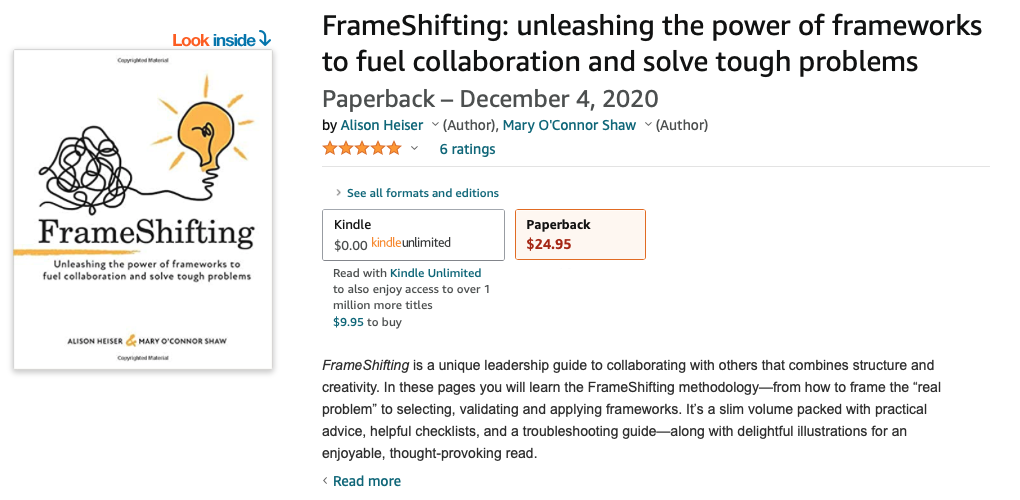
FrameShifting is a must-have guide for anyone who wants to learn to solve gnarly problems—and, importantly, to solve the right problems—with greater insight and rigor. This book is packed with practical advice, helpful checklists, and a troubleshooting guide, along with colorful illustrations for an enjoyable, thought-provoking read.

Alison Heiser and Mary O’Conner Shaw drew upon their extensive experience working with prominent business leaders at global organizations to develop the concepts in their book.
In this case study, the co-authors of the book share how the concept of FrameShifting came into being and talk about their publishing journey. If you’re considering self-publishing, you’ll find the reasons they decided to self publish through Amazon KDP especially helpful.
Alison and Mary’s professionalism made this book a joy to bring to the finish line as I helped them with cover design, interior design and layout, and ebook conversion.
Alison and Mary’s Book Done Timeline
From concept to completion, FrameShifting took just over three years to materialize.
🐣 Idea hatched: August 2017
✍️ Writing started: October 2017
🎨 Files ready for editing, design and layout: September 2020
✔️ Book done (released): December 2020

Alison and Mary’s Book Done Take-Aways
Here I interview Alison and Mary about what they learned during the process of getting their book ready for publication.
How did you come up with your book's title?
Jim Heiser (Alison's husband) coined the term "FrameShifting." and we crafted the sub-title. We wanted something that described not just what FrameShifting is, but what it can do for the reader. During our journey to Book Done we trademarked the term “FrameShifting”.
Tell me a bit more about the cover design you chose.
During our initial consultation, Julie listened carefully as we described our vision. She presented several cover designs, but her first one was our immediate favorite. Like the lightbulb illustration on the cover, her clean, crisp design captured the concept perfectly. We loved it at first sight and we still do—it's a timeless design!

Why did you decide to self-publish, rather than go down the traditional publishing route? Which print-on-demand printer did you use and why?
After doing our research, we decided to use the Amazon KDP platform to self-publish our book because:
We knew exactly what we wanted the book to look like and didn't want to compromise on our vision through collaboration with a publisher.
We also felt that the content was timely (with the pandemic presenting unprecedented challenges to business leaders) and we wanted to expedite publication.
Finally, for convenience: Amazon KDP enabled us to get both our print and e-book products into readers' hands quickly and efficiently.
What was the biggest surprise during your book project?
We were surprised how many times it was possible to go through the manuscript with a fine-tooth comb and still miss things, so engaging with a professional proofreader was certainly money well spent.

Which part of your book project was the most rewarding?
We loved the creative collaboration with each other and with everyone who contributed to the final product. Nurturing this book from a seed of an idea to a real, tangible book was one of the most fun, rewarding and challenging experiences of our careers.
Which part of your book project took longer than you expected, and why?
Working with traditional publishers was time-consuming! Self-publishing was way faster!
It also took a long time for early readers to provide voluntary feedback.
Getting the book from final manuscript stage to print-ready only took about two months, but it felt like a lot longer. At this stage, every detail counts and you can't afford to lose focus. (Here, we must credit Julie for injecting fresh energy and creativity into the process. She re-energized us and brought the book to life with her design and layout. When we were starting to lose steam, Julie never took her eye off the ball, making sure everything was perfect.)

When you write another book, what will you do the same way? What will you do differently?
This book was a pretty big undertaking. But, if we were to do it again, we would probably do it the same way. We’re really glad that we engaged other professionals for specialized tasks, like editing, proofreading, and design/layout. Their contributions helped us produce a book to be proud of.

✏️ Every chapter in FrameShifting ends with a Notes page (for linear thinkers) and a Sketches page (for the artists among us)!
Alison and Mary’s Book Done tips:
Send pre-launch copies of your book to key reviewers. This will provide useful feedback for your launch, and useful content to share on social media, too.
If you plan to self-publish on Amazon KDP, create a short manuscript to use as a test file for working with the KDP software. This will help you understand the settings and quirks of KDP. Then, when your designer gives you the final book files for your launch, you’ll know exactly how to get it uploaded and ready to distribute, and won’t lose any time working out KDP bugs.
Consult published authors for advice!
🐛The KDP uploading bug is real! So many authors tell me that they lose time or almost launch their books late because of problems with KDP’s software or process. This tip about using a test file is gold!
Alison and Mary’s Book Done technical details:
Amazon KDP and other print-on-demand printers offer a limited number of paper types and book sizes. If you need an unusual size or paper, you may need to print with a traditional printer.
Quantity ordered: no minimum quantity (print on demand)
Page count: 126
Dimensions (page size): 7.5 x 9.25 inches
Binding: Paperback
Interior details
Ink colors: Full color
Paper: White bond, matte finish
Bleed: Yes*
Cover details
Cover stock: 100# white paper with matte finish
Ink colors: Full color
*Bleed refers to whether your book has images or graphics that go off the edge of the paper. This is important for the printer to know, because it determines how big the sheets of paper your book is printed on need to be.
What’s next for your book?
I hope Alison and Mary’s story has been inspiring, no matter where you are on your journey to book done. ✔️ What kind of book project are you working on? Find out if you are ready to work with a book designer or sign up to get more of these case studies in your inbox via my newsletter!